It’s quite a surprise that, of all my articles and essays, the one about professional boxing’s weight classes is by far the most popular one I’ve ever published, at least to me. It’s not that I don’t think it’s some of my more well-written work; it’s just surprising that particular subject is the one readers are most interested in. Having already made a passing reference to the changing nature of the UFC’s weight classes in my essay on boxing’s weight classes and being the combat sports fan that I am, I’ve decided to once again come up with another play on the title of one of F. Scott Fitzgerald’s works and analyze the evolution of the UFC’s weight classes.
There had been spectacles such as Muhammad Ali vs. Antonio Inoki before the inaugural UFC event on November 12th, 1993; however, The Ultimate Fighting Championship, as it was billed initially before being retroactively titled UFC 1: The Beginning, was the first real showcase in the United States of what would become the sport of mixed martial arts. The idea of various fighters using different forms of traditional martial arts and other combat sports to compete and see which one was the best was a main selling point of the early UFC events. The brand changed hands frequently within the first seven years of its existence and quickly developed from a no-holds-barred street fight with no time limit and no weight classes into the beginnings of a legitimate sporting contest legitimized by state athletic commissions; the idea of different styles merging had to be an inevitable conclusion at some point. Therefore, it would necessitate that the UFC introduce judges, time limits, weight classes, and more rules to be viewed as more than just human cockfighting1, as it was in its early days. Interestingly enough, the UFC implemented weight classes before they permanently did away with the tournament-style set-up of competition for an event. While UFC 9 was the first to have the now standard card of regular bouts instead of a tournament-style set-up or at least a tournament with a “super fight” to close the show, it still did not feature weight classes, and the UFC returned to the tournament-style set-up at fan request following UFC 9.
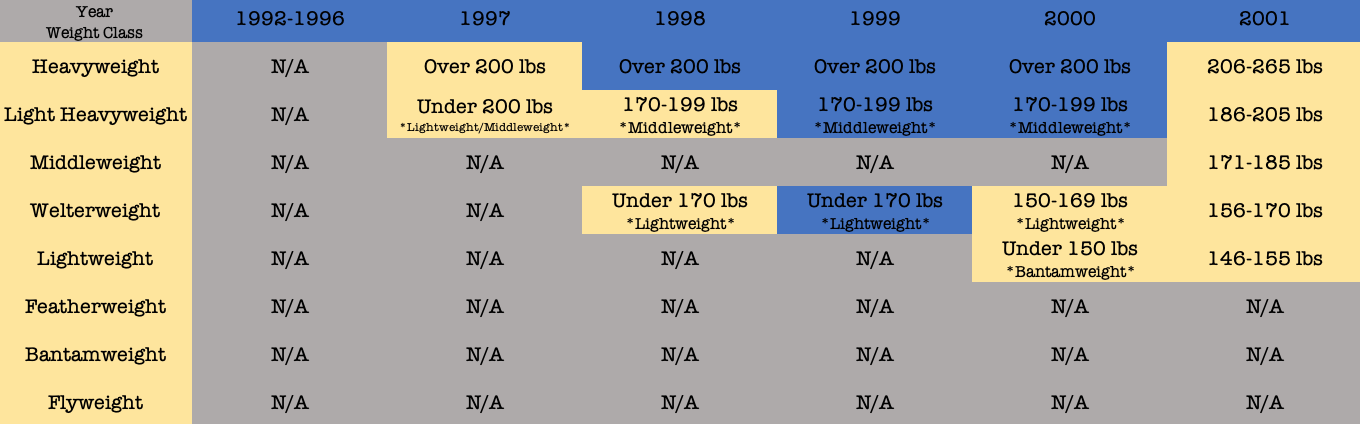
The UFC introduced two weight classes to compete in separate tournaments for UFC 12 on February 7th, 1997; those weight classes were heavyweight, encompassing anyone over 200 lbs, and lightweight, encompassing anyone under 200 lbs. UFC 12 also was the first event to introduce a championship belt, with Mark Coleman winning the inaugural UFC Heavyweight Championship by forcing Dan Severn to submit to a neck crank. At UFC 14, they changed the weight classes, with lightweight now referred to as middleweight; Frank Shamrock submitted Kevin Jackson via armbar to win the inaugural UFC Middleweight Championship at the UFC Japan event on December 21st, 1997. UFC 14 was also the first UFC event requiring fighters to wear padded gloves when competing, and UFC 17 was the final time they used a tournament-style set-up, other than one exception for UFC 23. UFC 17 also has the distinction of the usage of the term mixed martial arts more frequently on commentary and by the fighters rather than no-holds-barred fighting to improve the image of the sport, or more accurately, legitimize it as a sport, considering the negative publicity from the mainstream American media to the UFC at the time.
Just 154 days after UFC 17, but 1,799 days after the inaugural UFC event, Pat Miletich would defeat Mikey Burnett by a split decision to win the inaugural UFC Lightweight Championship at UFC Brazil: Ultimate Brazil on October 16th, 1998. While a fourth weight class, bantamweight, wasn’t added until UFC 26 on June 9th, 2000, the Council of the Mixed Martial Arts Commission2 tweaked the rules and regulations starting with UFC 21 on July 16th, 1999. Every standard fight was now subject to a five-minute, three-round time limit, with championship and main event fights given a five-minute, five-round time limit. The UFC also implemented a 10-point scoring system along with these time limit changes, shortening one single 21-minute fight into a more professional sporting contest that leads to more consistent judging and scoring, in theory. Following that, the next set of changes to the rules and regulations came at UFC 28 on November 17th, 2000.
The New Jersey Athletic Control Board began allowing mixed martial arts promoters to hold events3 in their state in September 2000 after reviewing attempts made by the California State Athletic Commission4 in April 2000, leading to UFC 28 being the first event held in a state outside of Alabama, Georgia, Mississippi, Louisiana, Iowa, or a foreign country since UFC 9, subtitled Motor City Madness. UFC 28 was also the penultimate UFC promoted by SEG and the final UFC event hosted in the United States by SEG, as UFC 29 took place in Tokyo, Japan, on December 16th, 2000. The Fertitta brothers and Dana White founded Zuffa a few weeks later, acquired the rights to the UFC for 2 million dollars, and quickly turned around and hosted UFC 30 on February 23rd, 2001, back at the Etess Arena, now Hard Rock Live, an arena in Trump Taj Mahal. It was the first of a long list of Zuffa-promoted events in UFC’s history and the final UFC event not held under the Unified Rules of Mixed Martial Arts, as the NJSACB hadn’t created them until April 2001. UFC 31 was an enormous milestone in the history of the incredibly young sport, as the now standard Unified Rules of Mixed Martial Arts were in effect, and with it, changes to the weight classes.
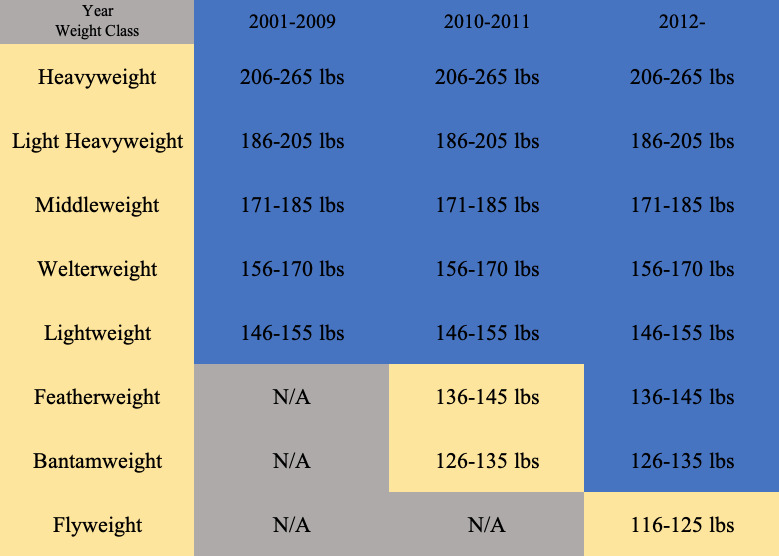
To review, the UFC went from having no weight classes to having two in 1997, which were incredibly simple to understand; guys who fought at 200 lbs and above were heavyweights, and guys who fought under 200 lbs were lightweights, at least until five months later when they started getting referred to as middleweights. However, this is not a considerable change, and it’s likely more fitting as it’s slightly silly to categorize someone who fights professionally at 199 lbs as a lightweight. The arrival of the lightweight division at UFC 16 on March 13th, 1998, began to shape the mold for modern weight divisions, as this weight class was for fighters weighing under 170 lbs. Bantamweight was when the weight classes became much more clearly defined, as it was intended for fighters under 150 pounds, necessitating a more formalized standard to the other three weight classes. The four instituting weight classes of MMA became cemented with a new division to bridge the gap between the newly-renamed welterweight and light heavyweight divisions, and the term “middleweight” was still given use as it became the name of the new 171-185 pound weight division.
However, as Zuffa slowly began turning around the fortunes of the UFC, another small MMA promotion opened its doors in 2001, World Extreme Cagefighting. While managed on a much smaller scale with a less well-known and marketable name, WEC provided an infrastructure that the UFC would later absorb and assimilate into its structure to provide a more well-rounded product. It took Zuffa a while to turn around the fortunes of the UFC, with UFC 40 becoming their most successful event at that point with a near sell-out at the MGM Grand built on the hype5 between the main event between Tito Ortiz and Ken Shamrock on November 22nd, 2002. However, on January 17th, 2005, they aired6 The Ultimate Fighter, with The Ultimate Fighter: Ultimate Finale, or The Ultimate Fighter 1 Finale, if you’d like to keep things in perspective, also being a stand-out successful event for the UFC, allowing them to break into not only pay-per-view but cable television as well. The Ultimate Fighter 1 Finale aired on Spike TV on April 9th, 2005, and with the UFC breaking their live gate and pay-per-view buy rate records with UFC 57 and UFC 61, it should be no surprise they were able to purchase WEC by December 2006; scrapping their entire heavyweight division in the process.
However, this proved beneficial to WEC anyway, as they never had an active champion at the higher weight classes, allowing them to focus on the lighter weight classes. WEC had created a featherweight division early on, awarding Cole Escovedo the inaugural WEC Featherweight Championship after defeating Philip Perez at WEC 5 on October 18th, 2002. Starting in 2006, however, with a win over Escovedo no less, Urijah Faber dominated their featherweight division, defending the belt five times until he finally lost to Mike Brown at WEC 36 on November 5th, 2008. WEC didn’t create a bantamweight division until early 2006, but that was fine as Gabe Ruediger and Hermes França held down their lightweight championship throughout 2004 and 2006 until Zuffa purchased them and moved all their relevant talent up to the UFC roster, forcing them to restart their lightweight division from scratch. This event was significant, as until UFC 64 on October 14th, 2006, the UFC’s lightweight division had been on hiatus after B.J. Penn and Caol Uno fought to a draw for the already-vacant championship at UFC 41 on February 28th, 2003, due to Jens Pulver vacating the UFC Lightweight Championship and leaving the UFC over a contract dispute on March 23rd, 2002.
By the time future UFC names won the WEC Lightweight Championship, the bantamweight division had already seen the title change hands three times after Eddie Wineland was declared inaugural WEC Bantamweight Champion with a head kick KO over Antonio Banuelos at WEC 20 on May 5th, 2006. Dominick Cruz defeated Brian Bowles to win the championship at WEC 47 on March 6th, 2010, defended his belt one more time under normal circumstances, and then won the inaugural UFC Bantamweight Championship when he defended and retired the WEC Bantamweight Championship at WEC 53 on December 16th, 2010, the final WEC event. By this point, WEC had long dissolved their light heavyweight and middleweight divisions, both on December 3rd, 2008, after WEC 37, with welterweight to follow not too long after the WEC canceled the Carlos Condit vs. Brock Larson fight that was supposed to take place at WEC 39 on March 1st, 2009 after Larson had to pull out of the fight against Condit, who was the champion, due to suffering an injury during training. WEC 40, on April 5th, 2009, was their first focusing on just lightweight, featherweight, and bantamweight until the UFC absorbed the WEC and adopted those weight classes to their already established weight divisions.
That gave us the seven weight class structure, but even that would only last a little over a year, as Dana White wanted to continue adding weight classes7, speculated by some as a way to break into the Asian market8; Demetrious Johnson won the inaugural UFC Flyweight Championship at UFC 152 on September 22nd, 2012. Once the UFC adopted the Unified Rules of Mixed Martial Arts in 2001, they began their takeover of mainstream MMA in North America, absorbing WEC, PRIDE, Strikeforce, and other smaller promotions as the 2000s progressed into the 2010s. That’s more or less how the current formation of UFC weight classes came to be, set into motion by the New Jersey State Athletic Control Board, slowly molding the UFC into the large corporate entity owned by a holding company with a hefty ESPN broadcasting contract that it is today.
Editor’s Notes
- Slate – 11/17/1999 – Fight Clubbed
- Hawaii.gov – Report No. 07-02 • February 2007 – Sunrise Analysis: Mixed Martial Arts • A Report to the Governor and the Legislature of the State of Hawai‘i – Chapter 2 • Direct regulation under the director of commerce and consumer affairs
- NJ.Gov – 9/5/2002 – Mixed Martial Arts Unified Rules of Conduct
- Sherdog – 2/22/2005 – MMA Vote Takes Place Today in California
- Sherdog – 3/18/2004 – The Voice of the Octagon
- epguides – The Ultimate Fighter • (a Titles & Air Dates Guide)
- SB Nation – 12/10/2011 – UFC Announces Four Man Flyweight Tournament For March 3
- Bleacher Report – 7/8/2011 – UFC: Is It Too Soon to Introduce the Flyweight Division in 2011?
 Havarti